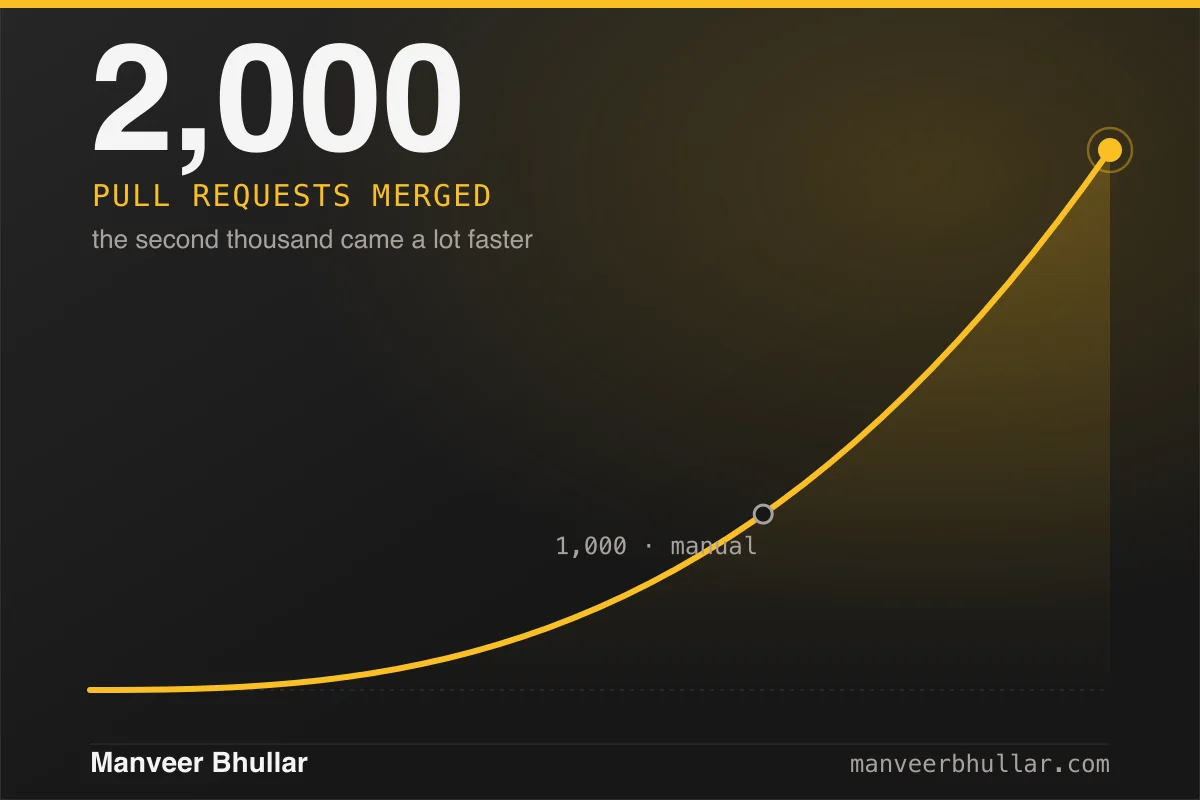
I started RoleReady in August 2025. The first thousand merged pull requests took about seven months. The second took four. I am now at 2000 merged PRs, just in the main webapp repo. This obviously doesn’t include our marketing site, microservices, and earlier PoCs and prototypes.
How it used to go
Around the time I was crossing 1000 PRs, I was fully leaning into agentic workflows. I would have a dozen LLM agents open in my multiplex terminal, and would work with each one telling it what to do, how to approach our work, write plans, manually review them, remind them sometimes to write tests or how not to break things, etc. This worked very well, but I was not satisfied with it.
Leader and Follower model
Around this time I began to experiment with having one stronger LLM act as a coordinator for other agents. I’ve been using GLM as my main workhorse LLM agent, and I used Claude Code agents as my ‘Leader’ agent. I would get my coding agents to write plans and notes to a shared space, where other agents and the Leader agent could access them. I would have the Leader LLM review and fix all plans, fix conflicts, and report status back to me via markdown, HTML, even before-and-after images through Playwright. This also let me easily work across all my codebases, often getting the leader to coordinate two agents working on the webapp and the marketing site at the same time to keep them in sync (e.g. when doing the color theme overhaul or setting up the changelog integration).
I could get the concept working but it was obvious I was bending tools and relying on prompts to force my workflow into a shape that wasn’t quite the fit.
My tinkering and experimenting also included trying all the popular harnesses as they came and went (mostly through Hacker News frontpage) like Superpowers, Karpathy’s skills, g stack, etc., but I was never ever happy with them. It always felt like just posturing and performative LLM wrapping to me. At this point I knew I either had to create my own harness properly (a non-starter: I know enough to know how much I don’t know, and there isn’t time to learn it (lol)) or wait for someone smarter than me to create it.
Firstmate
Last month, I came across this video:
I highly recommend everyone watch it. The author, Kun Chen, very clearly walks through setting up a modern multiplex terminal agentic workflow, and then shows off the tool he made, Firstmate. The basic idea is you only talk to the firstmate, who orchestrates a fleet of crew member LLMs to accomplish the task. Each task works in its own git worktree, and the firstmate is able to coordinate them all to keep them in sync. And it works surprisingly well. I’ve given it super complicated tasks across multiple codebases, and it was able to orchestrate a dozen agents, work through everything, fix merge conflicts, and get it all done.
My confidence in my firstmate workflow is high enough that I often just paste raw logs, and say “fix” and I can expect a PR open in a few minutes. And this is all done with existing coding harnesses. My personal setup is opencode/grok as the firstmate, with crew members mainly being opencode using GLM 5.2. I also sometimes use a ‘secondmate’ using Claude Code (fable when it was available) for really complicated tasks.
I often find myself at the end of the day spending a lot of time figuring out 10-20 tasks that the firstmate can handle overnight. I wake up to the morning, ask the firstmate how the night went, and it tells me “ 10 cycles shipped, 70 PRs merged” and that number doesn’t scare me because I know the changes are done well.